

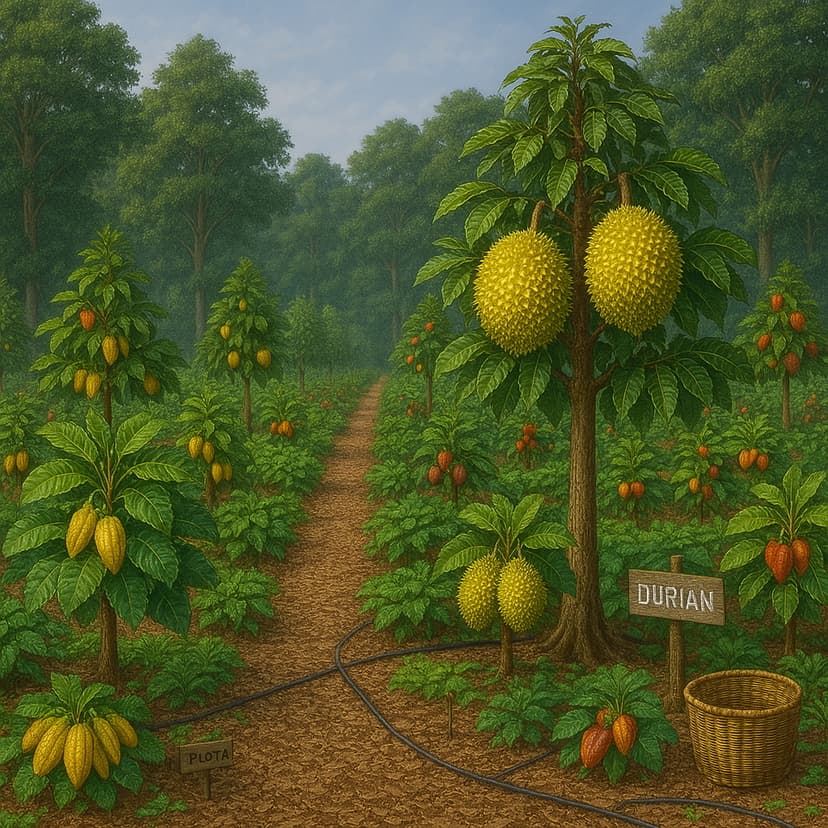
High Density Agroforestry (Specialty Crop Focus)
System Type: High Density AgroforestryAn intensive agroforestry model focused on premium crop cultivation (e.g., Durian), mimicking natural forest structure using precision planting. Tests potential for maximizing Return on Regeneration through high-value, multi-crop production, boosting profitability and green job creation per hectare....
Methodology Overview
An intensive agroforestry model focused on premium crop cultivation (e.g., Durian), mimicking natural forest structure using precision planting. Tests potential for maximizing Return on Regeneration through high-value, multi-crop production, boosting profitability and green job creation per hectare. Drives operational efficiency (tracked via cost analysis) and investment appeal via data-driven optimization while maintaining soil health (using organic inputs) and functional biodiversity.
Focus Pillars
Indicative Density
1,800 stems/hectare (Note: Actual density varies by project design)
🌱 Regenerative Reforestation Flow (Per Hectare)
- Seed Discovery & Provenance Tracking
→Community-led identification, collection, and tagging of diverse native seeds based on ecological and cultural value.
- Nursery Propagation & Infrastructure Setup
→Germination, soil conditioning, pest prevention, and nursery infrastructure including solar, irrigation, and potting systems.
- Site Preparation & Ecological Design
→Land clearing/slashing, GPS-based planting layout, soil improvement, and path/machinery access integration.
- Tree Planting & Ground Integration
→Auger-assisted digging, watering-in, volunteer-supported planting, mycorrhizal pairing, mulching, and biodegradable weed mat application.
- Ongoing Care, Stewardship & Biodiversity Management
→Spot and full mulching, herbicide-free weed control, ongoing irrigation, fertigation, pest monitoring, and pig fencing where needed.
- Ecological Intelligence & Transparent Monitoring
→Drone surveys, LIDAR scans, biodiversity and soil health surveys, geotagged reporting, and map-based progress tracking.
Potential Adaptations
- Can emphasize Native species for higher biodiversity goals.
- Can focus on High-Density specialty crops for profit maximization.